Some experience · 23.0 litres · Medium-bodied dry red
Marquette
A cold-hardy hybrid that makes a genuinely serious red from a vine that survives minus thirty. It arrives at high sugar and ferocious acidity at the same time, which is the hybrid signature and the whole problem.
Starting sugar
23.5 Brix
5.95 kg of fermentable sugar
Original gravity
1.099
from the ingredients, not asserted
Finishing gravity
0.995
dry
Alcohol
13.6%
Brix alone predicts 12.9 to 14.1%
Residual sugar
0 g/L
approximate, from gravity
Ready after
9 months
best around 3 years
Made to Medium-bodied dry red, and every computed figure lands inside the published range for it.
ABV inTA inpH inRS inWhat decides this wine
The acid, and there is no single fix for it. Malolactic takes about two grams per litre off, cold stabilisation drops tartrates and takes a little more, and potassium bicarbonate handles the rest. Doing only one of the three leaves you with a wine nobody finishes.
What goes in
| Ingredient | Weight | Sugar | Volume | Share of sugar |
|---|---|---|---|---|
| Marquette23.5 Brix (picked off the midpoint) Picked at 23.5 rather than left to 26. Hanging longer raises the sugar and barely touches the acid. | 36.00 kg | 5.95 kg | 23.04 L | 100% |
The ingredients contribute 23.0 litres and the water makes up the rest to 23 litres. Those figures are checked against each other when the site is built, because a recipe whose volumes do not add up produces a wine weaker or stronger than every number above.
Acid and sulphite
Acidity of the must
10.5 g/L
at pH 3.25
After malolactic
8.5 g/L
malolactic takes roughly 2 g/L with it
Potassium bicarbonate
51 g
to reach 6.5 g/L. Bench trial before treating the batch
Sulphite at bottling
0.9 g
potassium metabisulphite, for 22 mg/L free SO2 at pH 3.45
The batch
- Must volume
- 23 L
- Ferment at
- 22-27 C
- Molecular SO2 target
- 0.5 mg/L
- Malolactic
- Yes
- Yeast
- BM 4x4to 16%, medium N
The sulphite figure is worked out against the pH of the finished wine, not of the must. Malolactic and deacidification both raise pH, and dosing a finished red to its must pH under-protects it by roughly a third. Recompute for your own reading.
Method
- 01Destem and crush. Measure TA properly rather than guessing; hybrids routinely come in above 10 g/L.
- 02Sulphite at 50 mg/L and pitch.
- 03Ferment at 22 to 27C, punching down twice a day, and press at dryness after about a week.
- 04Malolactic is not optional here. Inoculate with a low-pH strain and hold it at 20C until the paper chromatography shows no malic left.
- 05Cold stabilise near freezing for a fortnight, which drops tartrate and takes another gram of acid with it.
- 06Bench trial potassium bicarbonate on a small sample before treating the batch, then treat to the figure the trial gives.
- 07Bulk age six months and bottle.
The two instruments this recipe needs
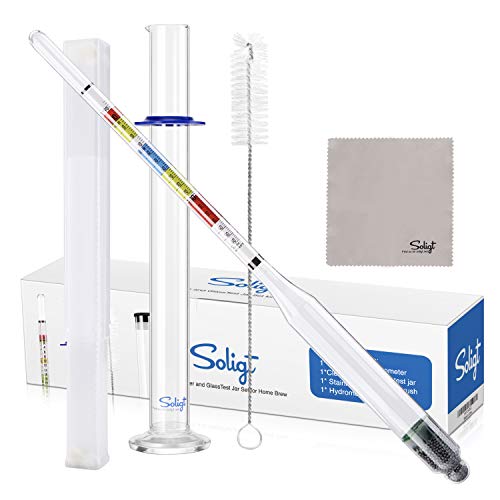
Every number on this page came from a hydrometer reading and a pH reading. Without those two you are following a recipe rather than making a wine, and the sulphite figure in particular is meaningless without a pH you have actually measured.
Measuring
Hydrometer and trial jar
SOLIGT Triple Scale Hydrometer and Glass Test Jar for Wine, Beer, Mead & Cider - ABV, Brix and Gravity Test Kit
$18.98
Tracks the ferment from must to dry. The gap between your starting and finishing gravity is the only reliable way to know the alcohol you actually made.

Measuring
pH meter
Apera Instruments AI1113 pH Calibration Buffer Solution Kit (7.00, 4.00), 8 oz. Each
$18.00
The most important instrument on this page. pH decides how much of your sulphite is actually protecting the wine, and dosing without knowing it is guesswork.